The construction and plant engineering industry is becoming more complex every year. Large project sizes, tight schedules, rising material costs, and strict quality requirements make traditional project planning methods less effective. To solve these challenges, companies are increasingly adopting AI-Based Project Planning and Cost Control systems.
Artificial Intelligence (AI) is transforming how construction and industrial projects are planned, monitored, and controlled. By analyzing large volumes of data, AI helps project teams make smarter decisions, reduce risks, and keep projects on time and within budget.
🔔 Get Latest Job Alerts
Join our official WhatsApp & Telegram channels for daily construction and engineering job updates.
What Is AI-Based Project Planning & Cost Control?
AI-Based Project Planning & Cost Control is the use of artificial intelligence, machine learning, and data analytics to plan project schedules, allocate resources, predict risks, and control costs throughout the project lifecycle.
Unlike traditional planning tools that rely on static schedules and manual updates, AI systems continuously learn from:
- Historical project data
- Real-time site information
- Cost trends and market data
- Productivity and performance metrics
This allows project managers to predict outcomes instead of reacting to problems after they occur.
Why AI Is Important for Modern Construction Projects
Construction and plant projects often face issues such as:
- Schedule delays
- Budget overruns
- Poor resource utilization
- Inaccurate cost estimates
- Unexpected risks
AI helps overcome these challenges by providing data-driven insights and automated decision support.
Key reasons AI is essential:
- Projects are larger and more complex
- Cost pressure is increasing
- Margins are shrinking
- Clients demand transparency and accuracy
How AI-Based Project Planning Works
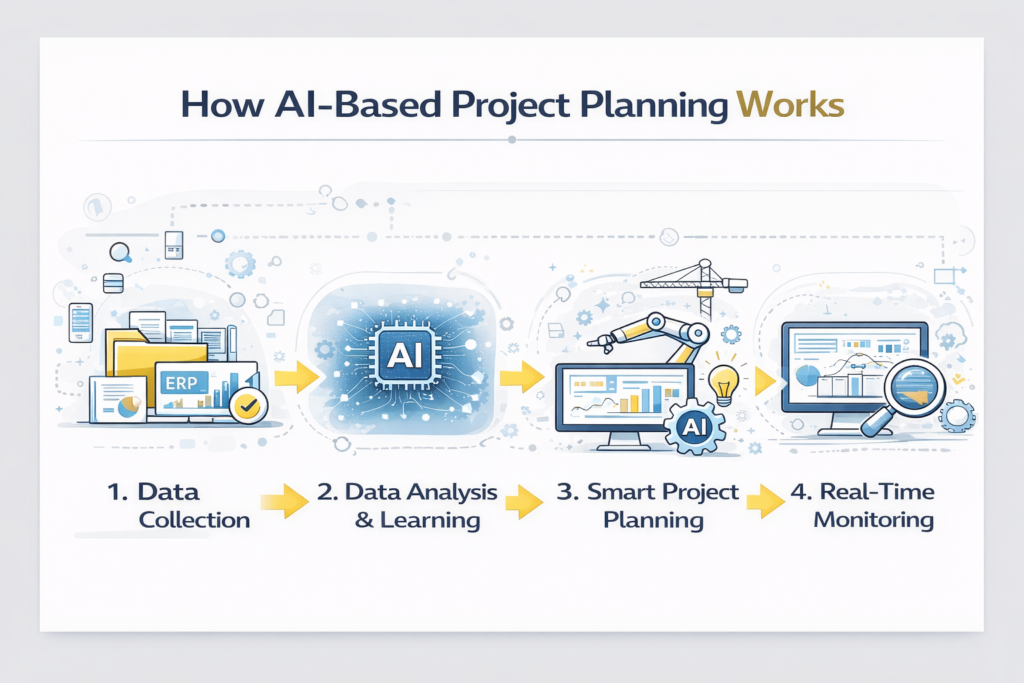
1. Data Collection
AI systems collect data from multiple sources such as:
- Project schedules
- Cost estimates and BOQs
- ERP and accounting systems
- IoT sensors and site reports
- Past project records
2. Data Analysis & Learning
Using machine learning algorithms, AI analyzes patterns related to:
- Productivity rates
- Cost fluctuations
- Delay causes
- Resource performance
The system continuously improves as more data is added.
3. Smart Project Planning
AI automatically:
- Creates optimized schedules
- Suggests resource allocation
- Identifies critical activities
- Highlights high-risk tasks
4. Real-Time Monitoring
As the project progresses, AI compares planned vs actual performance and alerts teams about:
- Cost overruns
- Schedule slippages
- Productivity drops
5. Predictive Cost Control
AI predicts future costs and cash flow, enabling early corrective actions.
AI-Based Cost Control in Construction Projects
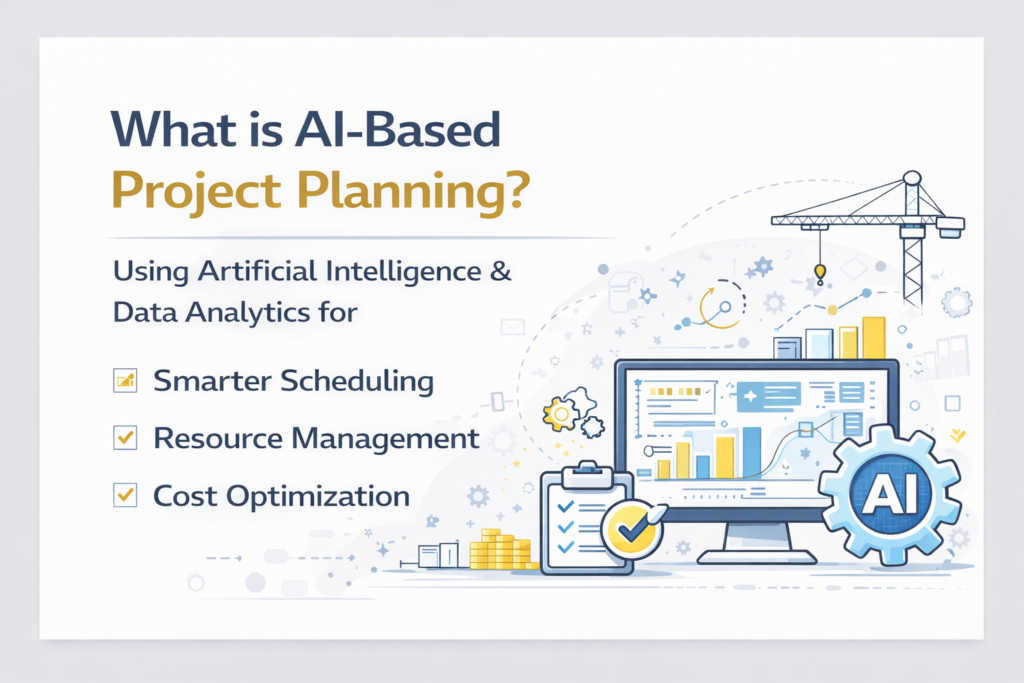
Cost control is one of the biggest challenges in construction and plant engineering. AI improves cost management in several ways:
Accurate Cost Estimation
AI analyzes historical cost data and market trends to generate more accurate project budgets.
Real-Time Cost Tracking
Instead of monthly cost reviews, AI provides live cost dashboards showing:
- Actual cost vs budget
- Cost variance
- Forecasted final project cost
Early Risk Detection
AI identifies cost risks such as:
- Material price escalation
- Low productivity
- Design changes
- Equipment downtime
Automated Reporting
Manual cost reports are replaced with automated, data-driven insights.
Industrial Applications of AI-Based Project Planning
Construction Projects
- High-rise buildings
- Infrastructure projects (roads, bridges, metro)
- Industrial plant construction
Plant Engineering
- Power plants
- Oil & gas facilities
- Manufacturing plants
- Cement and steel plants
EPC Projects
AI supports EPC contractors by improving coordination between engineering, procurement, and construction teams.
Key Benefits of AI-Based Project Planning & Cost Control
1. Improved Planning Accuracy
AI reduces guesswork and creates realistic schedules and budgets.
2. Reduced Project Delays
Potential delays are identified early, allowing preventive action.
3. Better Cost Control
Continuous monitoring prevents cost overruns and budget surprises.
4. Optimized Resource Utilization
Labor, machinery, and materials are used more efficiently.
5. Faster Decision-Making
Project managers receive actionable insights instead of raw data.
6. Increased Profitability
Better control over time and cost leads to higher project margins.
AI vs Traditional Project Planning
| Traditional Planning | AI-Based Planning |
|---|---|
| Manual scheduling | Automated, optimized schedules |
| Static project plans | Dynamic, adaptive planning |
| Reactive problem solving | Predictive risk management |
| Periodic cost review | Real-time cost control |
| Human-dependent decisions | Data-driven decisions |
Challenges in Implementing AI in Construction
Despite its benefits, AI adoption comes with challenges:
- High initial investment
- Need for quality data
- Training and skill development
- Integration with existing systems
However, these challenges are temporary, while the benefits are long-term.
Future of AI in Project Planning & Cost Control
The future of construction and industrial projects is intelligent and predictive. In the coming years:
- AI will integrate with BIM and Digital Twins
- Autonomous planning systems will become common
- Real-time cost forecasting will be standard
- Decision-making will be faster and more accurate
AI will not replace project managers, but it will empower them to manage projects more efficiently and confidently.
Conclusion
AI-Based Project Planning & Cost Control is revolutionizing the construction and plant engineering industry. By combining artificial intelligence with real-time data, project teams can plan better, control costs effectively, and reduce risks.
As project complexity increases, AI will become a necessity rather than an option. Companies that adopt AI-driven planning today will gain a strong competitive advantage in tomorrow’s construction and industrial landscape.